
At first glance, planning a youth baseball or softball game lineup is a simple problem.
You have a roster, a handful of innings to play, and a few substitutions to manage. Maybe you rotate players between positions or make sure everyone gets a chance in the infield.
It seems manageable.
But when you look at the math behind it, the number of possible lineups becomes almost impossible to comprehend.
Let’s Start With One Inning#
Before we get into selecting players, let’s understand what we’re trying to do. A defensive lineup is an arrangement of players into 9 defensive positions. Traditionally, each position is numbered 1 through 9. But first, let’s start with a small example situation of just 3 positions: How many ways can we arrange 3 players to match 3 positions?
This is where factorials come in. 1
A factorial tells us how many different ways we can arrange items in order.
For example, with 3 positions (rows) — let’s say 3 players are the colored hats — the number of possible arrangements is:
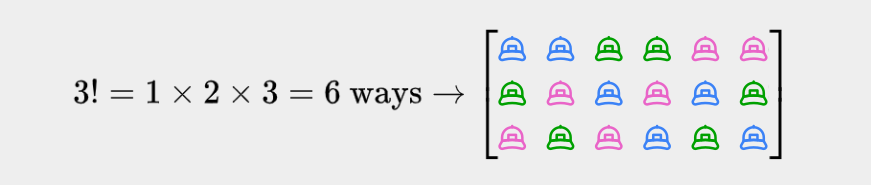
We already have multiple possibilities. There are 6 different ways to assign 3 players to 3 positions.
As the number of items increases, the number of possible arrangements grows extremely fast.
Now let’s apply that idea to a real baseball scenario. In a real game, we don’t just arrange players — we first have to choose which players are on the field, and then assign them to positions.
Imagine a typical youth baseball roster with 12 players. Only 9 players out of those 12 can be on the field at one time, because there are 9 defensive positions.
So the first step is choosing which 9 players are on the field, at one time (during one of the innings).
To calculate this, we use combinations 2, which count how many ways we can select a group without worrying about order.

This gives us:
220 unique groups of 9 players, chosen from a roster of 12.
Already, that’s more than most people would expect — but we’re not done yet.
Next, once those 9 players are selected, they must be assigned to specific defensive positions.
There are 9 defensive positions: P, C, 1B, 2B, 3B, SS, LF, CF, RF
Each position must be filled by one of the 9 players — and this is where factorials come back into play (imagine 9 rows of colored hats, extending the above example).
The number of ways to assign 9 players to 9 positions is 362,880.
In the colored hats example, that means 362,880 different columns are needed to represent every possible arrangement.

When we combine these two steps:
- choosing which 9 players are on the field
- assigning those players to positions
we get the total number of possible defensive alignments for just one inning:
220 × 362,880 = 79,833,600 possible lineups
That’s nearly 80 million different defensive alignments — for just one inning.
Now Multiply That Across a Full Game#
Most youth baseball games last 6 or 7 innings.
Even if you only considered different defensive alignments each inning (ignoring substitutions and batting order), the total number of possibilities grows astronomically.
We’re now talking about numbers so large that they quickly move into the trillions and beyond.
And that’s before considering real-world coaching constraints. Even adding just one more inning multiplies the possibilities again:
Setting your defense for 2 innings means choosing 1 option from 6,373,403,688,960,000 choices.
…assuming the game RSVPs can be trusted.
Real Lineups Include Constraints#
In reality, coaches aren’t randomly assigning players to positions. Instead, they are balancing a long list of league rules and goals:
- players should sit out roughly the same number of innings
- everyone should get time in the infield
- pitchers need required rest between appearances
- catchers can’t catch every inning
- some players have stronger defensive positions
- league rules may require minimum playing time
- a removed pitcher cannot pitch again in the same game
One way to think about this problem is like solving a Sudoku puzzle.
In Sudoku, each number must fit within a grid while satisfying constraints across rows, columns, and boxes. Changing one number affects multiple parts of the puzzle.

Lineup planning works the same way.
- Innings act like columns — each inning must have a valid defensive lineup
- Players act like rows — each player must be placed appropriately across innings
- Rules act like constraints — limiting where and when players can appear
In fact, lineup planning is often more complex than Sudoku:
- youth teams often have more players (e.g., 12) than positions (9), meaning someone must sit each inning
- players aren’t interchangeable — positions and skill levels matter
- rules change dynamically throughout the game (pitch counts, rest requirements, etc.)
So while a youth baseball game might have fewer “columns” than a 9x9 Sudoku grid because the games are less than 9 innings, it introduces additional dimensions of complexity that make the problem harder to solve.
Every additional rule adds another layer of complexity. Balancing league rules with player development creates a complex, constrained scheduling scenario that leads to a combinatorial explosion where potential lineup solutions grow astronomically. 3
This exponential growth makes exhaustive, manual planning impossible when relying on mental calculations or spreadsheets.
Humans aren’t naturally good at solving problems with millions or billions of possibilities. Which is why lineup planning often ends up happening in a notebook, on a spreadsheet, or mentally in the dugout between innings.
Sure, we can find a lineup that works — but it’s far from the best one.
Why This Matters for Coaches#
When coaches say lineup planning feels stressful, they’re not imagining it.

Even a simple youth baseball game involves:
- dozens of possible player rotations
- hundreds of possible defensive combinations
- thousands of ways to satisfy playing-time goals
Trying to track all of that mentally during a game can quickly become overwhelming.
This Is Exactly the Type of Problem Computers Solve Well#
Large combinatorial problems are actually a perfect use case for modern computing (Spoiler: Inningly solves large combinatorial problems).
Instead of manually juggling dozens of possibilities, a computer can evaluate millions of valid lineup combinations in seconds and identify ones that satisfy the rules you care about. This class of problems is known as combinatorial optimization. 3
In simple terms, the computer treats the lineup as a structured puzzle:
- which player plays which position
- in which inning
- while respecting every constraint
It then searches through the enormous space of possible combinations and finds solutions that satisfy all of the rules.
Modern optimization engines use advanced techniques such as constraint programming and integer optimization to do this efficiently. These same approaches are used in real-world scheduling problems like airline crew assignments, manufacturing shift planning, and logistics routing.
In other words, the math behind lineup generation is the same type of math used to schedule pilots and airplanes.
This is exactly the type of problem computers are designed to solve.
And it’s the idea behind Inningly.
Under the hood, Inningly’s lineup builder uses the same optimization technology used in airline scheduling and industrial workforce planning.
The lineup builder uses an optimization engine to evaluate thousands of possible defensive rotations while respecting the constraints coaches care about:
- balanced playing time
- pitching eligibility and rest rules
- position eligibility
- league playing-time requirements
Instead of forcing coaches to track every rule and permutation themselves, Inningly handles the heavy lifting behind the scenes and surfaces valid lineup options.
The goal isn’t to remove decision-making from coaching. The goal is to remove the mental math.
Coaching Should Be About the Players#
Youth coaches volunteer because they love the game and want to help players develop.
But modern youth sports include more logistics, rules, and coordination than ever before. Read: The Hidden Mental Load of Coaching Youth Baseball
Understanding just how complex lineup planning can become helps explain why tools that reduce that mental load can make such a difference.
Because at the end of the day, the best place for a coach’s attention isn’t a spreadsheet, a lineup chart or a dry-erase board. It’s the game happening right in front of them.

Sources#
-
Weisstein, Eric W. “Factorial.” MathWorld—A Wolfram Resource. View on wolfram.com ↑
-
Weisstein, Eric W. “Combination.” MathWorld—A Wolfram Resource. View on wolfram.com ↑
-
Combinatorial Problem. Science Direct. View on ScienceDirect.com ↑↑